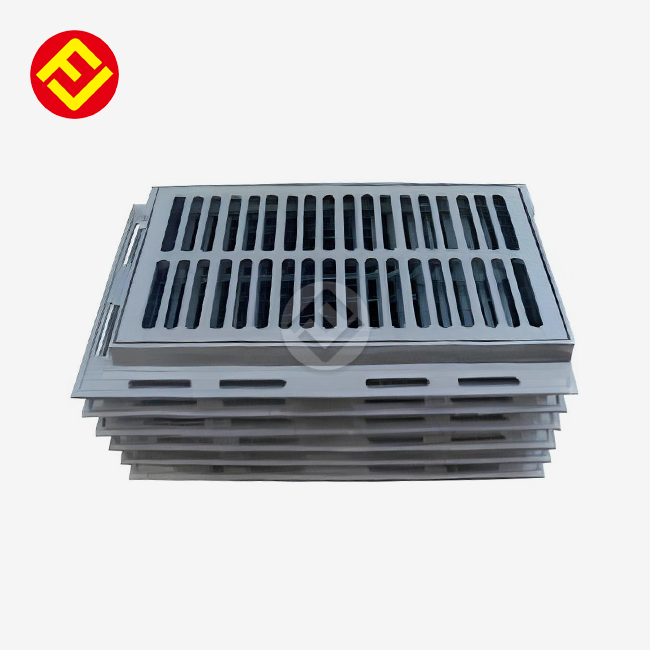
Rainwater Grate


Product Name: Gully Cover
Material: Ductile Iron
Load Ratings: B125, C250, D400, E600
Dimensions: Customizable length, width, and height to fit your exact installation needs.
Rainwater Grate in Ductile Iron: B125 to E600 Load Ratings and Custom Sizes
Roads carry gully covers. Paths carry them too. Yards do as well. Ductile iron is the material used by FLA Industrial & Trading Co., Ltd. The Rainwater Grate comes in four load classes: B125, C250, D400 and E600. Pick the class that fits the job. A footpath may be the site. It can sit by a roadside too. So does a main road or a heavy-duty site. Length can change. Width and height can change as well. When no standard size fits the opening, odd shapes are possible. Send the opening size. Include the seating depth. Tell us the traffic that will cross it. Before production starts, our team confirms the material and the performance figures. Dimensions are checked at the same time.
What a Gully Cover Does
A gully cover is the layer between runoff on the surface and the drain underneath. Storm water enters through This product. That same grate holds the weight of people or vehicles. Leaves stay out of the drain line. So does trash, and so do branches. A loose fit makes a cover rattle. So does the wrong load class. Repeat loading can crack it. Salt in the ground speeds up corrosion. Chemicals do the same. Let the site decide which cover you buy.

Specifications
| Specification (mm) | Load Capacity | Specification (mm) | Load Capacity |
|---|---|---|---|
| 590×480×20 | A15 | 380×500×20 | A15 |
| 590×300×20 | A15 | 350×500×40 | C250 |
| 500×500×40 | C250 | 350×500×30 | B125 |
| 500×500×30 | A15 | 350×500×30 | B125 |
| 450×750×40 | B125 | 320×500×20 | A15 |
| 450×750×30 | A15 | 300×500×40 | C250 |
| 400×600×40 | C250 | 300×500×30 | B125 |
| 400×600×30 | B125 | 300×500×20 | A15 |
| 400×500×40 | C250 | 250×500×30 | B125 |
| 400×500×30 | B125 | 200×400×20 | A15 |
| 394×594×30 | A15 | 340×500×20 | C250 |
| 380×500×40 | B125 |
Exact dimensions are not on this page. Unit weight is missing too. So is surface coating. Tell us what you need. Those details will be confirmed with you before production.

Why Ductile Iron
In ductile iron, graphite forms nodules. It does not form flakes. Tensile strength usually comes out above grey cast iron. Impact resistance gets better as well. The strength to weight balance is good, so a bulky cover is not needed. This metal does not wear down under compression. Wear and corrosion from the environment will not either. When you request a quote, please confirm the surface finish you want. Any coating needs should be stated too.
Choosing a Load Class Under EN 124
The right load class depends on where the cover is installed. Our gully covers are available in four classes:
- B125: sidewalks and pedestrian areas.
- C250: curbside channels.
- D400: built for main roads. EN 124 puts this class at a 400 kN test load.
- E600: docks and heavy-duty zones.
Pick a class too low for the traffic and the cover may fail. Match the rating to your site conditions before you order.
Application Notes
Municipal highways and arterial roads: A grate on a highway, a Rainwater Grate, faces other demands than one set into a paved plaza. Most people pick D400 or E600 here. Fast traffic tests how the cover seats and how well it holds steady. Talk to us about frame seating first. Before you order, ask which features cut noise or movement.
Industrial ports and logistics hubs: Forklifts and container trucks put down heavy point loads. Twisting forces show up too. Salt sits in the air at coastal sites. Chemical spills happen as well. Send us your load data and site conditions. Our team will then check which class fits and how the material should be treated.
Commercial pedestrian zones: B125 and C250 ratings are common here. Check slot width and access needs against the rules in your area.
Quality Checks to Request Before You Buy
Use this list when you compare suppliers:
- Dimensional verification: seating depth, clear opening size and frame flatness.
- Load test: a proof-load test that matches the stated class.
- Material analysis: the chemical makeup of the ductile iron gets checked. So does the graphite nodularity.
- Coating inspection: which coating it is and how thick it is, when the spec asks for a coating.
- Certificates: copies of the ISO and CE paperwork that cover your exact model.
Where a project calls for EN 124, work to that standard. Then ask for the test report that goes with your order.
Rainwater Grate Customization and Technical Support
Each Rainwater Grate can be made to your length, width and height. We also develop special-shaped parts for machinery, building materials and other industries, beyond the range of standard catalog Products" target="_blank" style="color:blue" >products. Support covers the whole order:
- Early stage: mold development for custom parts, plus 3D design and verification so you can see the product form before production.
- Middle stage: layout optimization and confirmation of material, performance and dimensional accuracy.
- Late stage: production progress feedback matched to delivery progress, so you always know your order status.

Supply and Certifications
FLA holds 2,000 tons of inventory for standard products. Custom and special-shaped orders can be delivered in as little as 7-15 days, and we respond with feedback on pricing, unit weight or 3D design within 24-48 hours. Most products carry ISO quality management system certification and CE product safety certification. Ask for the certificate that applies to your model, and confirm the schedule for your specific order.

Gully Cover FAQ
Q: How do I choose the correct load class?
A: EN 124 tells you how to pick the class. Start with where the product gets installed. Sidewalks take B125. Curbside channels need C250. Main roads use D400. Docks and heavy-duty zones take E600.
Q: Why is ductile iron a better pick than grey cast iron?
A: The graphite in ductile iron shows up as nodules. In grey cast iron it stays in flakes. That nodular shape is why the ductile grade usually handles more tensile strength. More impact also gets absorbed before it breaks.
Q: What details do I need to give you for a quote?
A: We need two things to start: the opening size and the seating depth. What kind of traffic goes over it? Let us know. Drawings you already have should be attached too. Will the site see salt? Chemicals? Heavy point loads? Add those to the list.
Q: What maintenance is needed?
A: Clear the debris out of the catch basin on a regular basis. Every so often, check the cover for cracks on the surface. Look for a frame that has sunk, or seating that has worn down.
Q: Can it handle chemical runoff?
A: Which chemicals you use, and how often, is what we need to hear first. Material and surface treatment get reviewed with you before production starts. Both are confirmed at that point.
Q: Can you make non-standard sizes?
A: Yes. We can build This product to your own length, width and height, and special-shaped parts are also possible. Delivery on custom orders can take as little as 7-15 days.
Contact Us
Got drawings, load requirements or an opening size? Email them to sales@flaindustrial.com and ask for a Rainwater Grate quote. We aim to reply in 24-48 hours.
YOU MAY LIKE