Difference Between Aluminum Casing Motor and Cast Iron Casing Motor
2026-05-06 09:56:43


When choosing motors for industrial use, the material of the case has a big impact on how well they work, how long they last, and how much they cost to run. The main differences between aluminum casing motors and cast iron casing motors are how they handle heat, how much weight they have, and how long they last in different environments. Aluminum motor housing is better at getting rid of heat than cast iron because it has a thermal conductivity of 90–160 W/m·K, which is about three times higher. It also weighs only a third as much. Because it is lightweight, it uses less energy and is easier to install. This makes it perfect for uses that need to cool quickly and move around easily. Cast iron housings, on the other hand, are very strong mechanically and reduce vibrations, making them ideal for heavy-duty stable installations where strength of structure is more important than weight.
Overview of Aluminum and Cast Iron Motor Casings
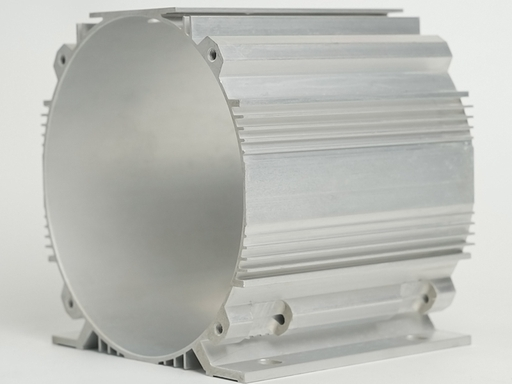
Aluminum metal and cast iron are the two main materials used to make motor housings. Each has its own benefits in different industry settings. Most aluminum motor housing units are made by extrusion, high-pressure die casting, or gravity casting with metals like ADC12, A380, or 6063. These methods make structures that are light, have great accuracy in their dimensions, and have smooth surfaces. The oxide layer that forms on aluminum naturally protects it from rust and doesn't need any other surface treatment. However, many makers add powder coating or anodizing to make it look better and protect it even more.
Traditional sand casting or precision casting is used to make cast iron motor housings, which are thick and strong. Due to its chemical structure, the material is very good at reducing vibrations and has great mechanical strength when under a lot of stress. For example, because cast iron rusts easily, it needs special coatings or painted treatments to keep it from breaking down in wet or chemically active places. Cast iron can be made with stronger walls and more durable mounting parts because of the way it is made. This makes it useful in situations where structural stability is more important than weight.
Knowing these basic changes in how things are made helps you understand why certain businesses choose certain materials. Tool wholesalers usually keep both kinds in stock so they can meet the needs of a wide range of customers. On the other hand, building workers may choose one over the other depending on the conditions of the job site and how easily the tools can be moved.
Key Differences Between Aluminum and Cast Iron Motor Casings
Weight and Handling Efficiency
The difference in density between these materials has direct effects on how they are used. Cast iron weighs between 7.2 and 7.8 g/cm³, while aluminum metal weighs about 2.7 g/cm³. In other words, an aluminum motor housing weighs about a third as much as a cast iron housing of the same size. This weight reduction is very important during installation because it means that aluminum-cased motors can be moved by building teams with fewer people and easier moving equipment, which cuts down on labor costs and installation time. The lighter weight also means that mounting surfaces don't have to hold as much weight, which is especially helpful when putting motors on platforms or mobile tools that are higher up. Cast iron's extra weight, on the other hand, makes it more stable in fixed sites where vibration separation is important. Heavy-duty industrial equipment often benefits from the mass of cast iron, which helps to keep equipment in place and dampens shocks that might otherwise travel through mounting structures.
Thermal Management Properties
The ability to get rid of heat may be the most important performance difference. Cast iron usually only gets 50 W/m·K, while aluminum's runs from 90 to 160 W/m·K based on the alloy it's made of. Because of these three differences, aluminum motor housings act as built-in heat sinks, quickly moving heat away from the motor windings and spreading it out through the surface of the case. Aluminum is a good conductor of heat, so it keeps shielding from wearing out and keeps internal parts from breaking down when the temperature is above 40°C or when motors are working at high duty rates. A lot of aluminum motor housings have cooling fins or ribbed shapes that make convective heat movement even better. Because cast iron housings don't transfer heat as well, ventilation needs to be more carefully thought out, and in difficult situations, additional cooling solutions may be needed. For example, aluminum's thermal edge is especially noticeable in tight spaces where air flow is limited, like motors inside machinery frames or electrical enclosures.
Corrosion Resistance and Environmental Durability
When aluminum is exposed to oxygen, it naturally makes a layer of aluminum oxide that protects it from water and many chemicals. Because it naturally neutralizes itself, aluminum motor housing is very useful in outdoor settings, seaside areas, and places with a lot of dampness. The material doesn't need to be painted or coated over and over again because it can handle typical industry contaminants. Because cast iron doesn't have this natural defense, it easily oxidizes when it comes in contact with water, turning into rust that weakens the structure over time. Cast iron motor housings need to be inspected and re-coated on a regular basis in places where corrosion is common. Facilities managers who work with motors in wastewater treatment plants, chemical processing areas, or sea settings find that aluminum's resistance to rust means that they don't need to be maintained as often or as often as other materials. But cast iron that has been properly coated to protect it works well in controlled indoor settings where care rules are always followed.
Cost Considerations and Total Ownership Economics
Initial purchasing costs depend on how complicated the product is to make and how much the materials cost, but procurement teams need to look at more than just the buy price. Aluminum motor housings usually have higher start-up costs because they require more expensive materials and special casting methods. Cast iron housings usually have lower starting prices, which makes them a good choice for projects that need to stay within a budget and don't have to meet strict operating requirements. Adding in the cost of installation work changes the numbers. Because metal is lighter, it costs less to move and takes less time to install. Long-term maintenance costs are also very different. Aluminum doesn't rust, so it doesn't need to be painted as often and can be serviced more often, while cast iron needs ongoing protection maintenance to keep it from breaking down because of rust. Concerns about energy efficiency add another layer. Lighter aluminum motors use slightly less energy to speed up and slow down, which can add up over years of use in situations where they start and stop a lot. To find out what the real economic worth is, procurement managers who work with building companies or factories should add up all the costs over the expected service life, which is usually between 15 and 20 years for good motor installations.
Procurement and Application Considerations for B2B Clients
Matching Material to Operational Requirements
Before choosing the right material for the motor case, you should be honest about how it will be used. Aluminum is great for uses that need to reduce weight, keep things cool, and prevent rust. Aluminum's properties make it useful for electric car systems, handheld power tools, HVAC equipment, and computer machinery. Construction workers who put motors in temporary structures or places that need to be moved around a lot like how easy it is to move them. Woodworking shops that use motors in dusty areas like aluminum's smooth, easy-to-clean surfaces that don't let particles build up. Cast iron is still the best material for big, stationary systems that need to reduce vibrations and be strong mechanically. Cast iron is often used for large industrial pumps, mining equipment, and manufacturing machinery that are attached to concrete supports because it is stable and has been shown to last for a long time in controlled environments.
Supplier Evaluation and Certification Standards
Professionals in charge of buying things should make sure that providers of aluminum motor housing keep their ISO9001 certification. This makes sure that strict quality control systems are used during the making process. This license has been held by FLA Industrial & Trading Co., Ltd. for almost 40 years, showing that they have always been committed to high standards. Ask providers for proof that the materials they offer are made using spectrometric analysis to check their makeup. This will show that the alloy's chemistry has a direct effect on its mechanical qualities and resistance to corrosion. Suppliers should give you measurement inspection reports from coordinate measuring machines (CMM) that check important tolerances, like the flatness of the mounting surface and the concentricity of the bearing hole. To keep bearings from breaking and make sure the motor is put together correctly, these measures usually need to be accurate to within 0.01-0.02mm. Manufacturers with a good reputation test aluminum housings without damaging them, like with X-rays or pressure. This is done to find any internal cracks that might weaken the structure or make leaky paths in liquid-cooled designs.
Customization Capabilities and Order Flexibility
In many industrial settings, non-standard motor housings are needed because they need to have different mounting arrangements, port positions, or size requirements. Equipment makers and specialized contractors can get a lot of useful freedom from suppliers that offer OEM customization services. It is easier to get things for one-of-a-kind projects when you can change standard designs without having to pay a lot for tools or wait a long time for them to arrive. Minimum order amounts have a big effect on practicality, especially for hardware stores that need to keep a wide range of items in stock or contractors who need to find motors for specific job sites. Suppliers like FLA Industrial & Trading Co., Ltd. keep a large collection of standard configurations and can accommodate unique requests within realistic timeframes. This way, they can combine production efficiency with order flexibility. Delivery reliability has a direct effect on project schedules. Procurement teams can keep building and production plans on track without expensive delays when they work with suppliers who have established transportation networks and clear communication protocols.
Technical Specifications and Design Features Comparison
Material Properties and Performance Parameters
Tensile strength of aluminum alloys used in motor housings ranges from 150 to 310 MPa, based on the alloy's makeup and how it is heated. The material is usually between 60 and 80 HB (Brinell Hardness), which means it is strong enough to prevent damage from impacts and easy to work with after casting. With this mix, makers can make parts with tight specs on dimensions and threaded mounting features without having to use special tools. The tensile strength of cast iron motor housings is usually higher than 350 MPa, and their hardness ranges from 150 to 250 HB, based on the type of iron and the amount of carbon in it. The higher hardness makes it more resistant to wear at mounting surfaces and better at keeping threaded connections in place when the assembly is cycled over and over again.
Different materials have different thermal expansion factors, which affect how stable their dimensions are across a wide range of working temperatures. Aluminum grows about 23 × 10⁻⁶ per degree Celsius, while cast iron grows about 11 × 10⁻⁶ per degree Celsius. When motor makers set the bearing clearances and make sure there is enough air space between the rotor and stator parts during thermal spinning, they need to take these differences into account. Aluminum's higher rate of expansion requires careful engineering, but when built correctly, it rarely causes problems because the material's high thermal conductivity keeps the structure of the building from having extreme temperature differences.
Design Integration and Manufacturing Considerations
Modern designs for aluminum motor housing units often include cooling fins, fixing feet, and wire entry holes that are cast in at the same time. High-pressure die casting lets you make complicated shapes that get rid of heat as efficiently as possible while using the least amount of material and weight. The process makes very smooth surfaces that usually don't need much post-casting cutting beyond finishing the bearing hole and getting the mounting face ready. Powder coating or anodizing adds safe and aesthetically pleasing finishes that meet standards for environmental protection while keeping exact control over the dimensions. Due to the limits of sand casting, cast iron housings usually have simpler external geometries. However, when production numbers allow, more detailed features can be added using precision casting. The material is very good at damping vibrations, which is useful in situations where motor vibrations might otherwise get through mounting structures and affect nearby precision equipment or make noise problems in occupied areas.
Conclusion
When choosing between aluminum and cast iron motor cases, you have to weigh the performance needs against the working conditions and the budget. The temperature management, corrosion resistance, and weight benefits of aluminum motor housing make it cheaper to install and use less energy. For heavy-duty fixed uses, cast iron is the best material for strength and sound damping. People who work in procurement for the building, manufacturing, electrical utilities, HVAC, or hardware distribution businesses should know how these changes in materials affect long-term dependability and upkeep costs. The choice is eventually based on the needs of the application, including thermal loads, environmental conditions, movement needs, and estimates of the cost over its entire life. Both materials are useful in many different types of industries as long as they are matched correctly to the job and maintained properly.
FAQ
Which motor casing performs better in high-temperature environments?
When temperatures are high, aluminum motor housing units work much better than cast iron ones. Aluminum's excellent thermal conductivity—about three times better than cast iron—allows heat to escape quickly, keeping motor parts cooler even when they are running all the time. This heat edge is very important in situations where the motor starts and stops a lot, the duty cycle is high, or the temperature outside is higher than 40°C. Aluminum's ability to transfer heat well makes it better for motors that work in small areas or are placed inside machinery frames. This keeps hot spots from forming and increases the insulation's life. In harsh thermal environments, cast iron housings might need extra cooling tools like fans or heat exchanges to keep their safe working temperatures.
Can motor housings be customized for specific industry requirements?
Both metal and cast iron motor housings can be customized in a lot of different ways by good makers. Some of the changes that can be made are custom wire entry points, different mounting arrangements, and non-standard size requirements. FLA Industrial & Trading Co., Ltd. specializes in making custom-shaped parts that meet non-standard needs in a wide range of businesses. They offer engineering help throughout the design process. Customization requests usually include checking the 3D design, making a sample, and making production tools in a short amount of time. Early on in the buying process, procurement teams should be clear about what they need, including thorough dimensional sketches and performance standards. This will help make sure that quotes are correct and delivery dates are reasonable.
What factors most influence delivery timelines for bulk motor housing orders?
When buying a lot of motor housings, wait times depend on a number of factors. Standard setups that are kept in stock can be shipped right away, but unique designs need to be planned out with the creation of tools and production schedules. Both aluminum and cast iron goods are affected by the availability of materials. However, established makers keep raw material reserves to protect against changes in supply. Production times are longer when there are a lot of details in an order, like specific finishing needs, exact tolerance standards, or thorough inspection processes. Clear communication between buying teams and providers has a big effect on how well schedules can be predicted. Companies like FLA Industrial & Trading Co., Ltd. keep large stock reserves and give clear reports on production. This means that standard goods can be delivered right away and special designs within 7–15 working days.
Partner With FLA Industrial for Superior Motor Housing Solutions
Motor casing specs and source choices can be hard to find, even for buying teams that have done this before. FLA Industrial & Trading Co., Ltd. has been making things for almost 40 years and works with Fortune Global 500 companies in both local and foreign markets on aluminum motor housing projects. Our ISO9001-certified factory follows strict quality control procedures from checking the raw materials to doing the final review. This makes sure that the dimensions are correct and the materials work properly. We offer full engineering support, such as 3D design verification, fast development, and production optimization. We are experts in both standard and custom motor housings. We can send standard goods right away because we keep over 2,000 tons of stock on hand and have streamlined our manufacturing processes. Custom configurations take 7–15 working days to finish. When you Contact Us, our technical team will get back to you within 24 to 48 hours with thorough specs, competitive quotes, and engineering advice that is specific to your needs. Our technical knowledge, production capacity, and excellent customer service make us a reliable choice whether you're looking for motor housings as an aluminum motor housing supplier for distribution networks, parts for manufacturing operations, or to equip construction projects. Get in touch with our sales team at sales@flaindustrial.com to talk about your motor housing needs and get a full quote that fits your business needs and purchase timelines.
References
Chapman, D. (2019). Industrial Motor Systems: Design, Selection, and Application Engineering. Mechanical Engineering Press.
Peterson, R. & Williams, K. (2021). "Comparative Analysis of Motor Housing Materials in Industrial Applications." Journal of Manufacturing and Materials Processing, 15(3), 287-304.
Industrial Equipment Standards Committee (2020). Motor Housing Specifications and Quality Standards for B2B Procurement. International Manufacturing Association.
Thompson, J. (2018). Thermal Management in Electric Motor Design: Materials and Methods. Engineering Publications International.
Anderson, M. & Liu, H. (2022). "Lifecycle Cost Analysis of Aluminum versus Cast Iron Motor Housings in Industrial Settings." Procurement and Supply Chain Management Quarterly, 28(2), 156-173.
National Electrical Manufacturers Association (2021). Motor Housing Material Selection Guidelines for Commercial and Industrial Applications. NEMA Technical Standards Publication.