Grooved Concentric Reducer vs Reducing Coupling: Key Differences
2026-05-19 09:56:24


When planning industrial pipe systems, picking between a grooved reducer and a reducing connection has a big effect on how quickly and reliably the system is set up and how much it costs to maintain over time. Both fittings go from one pipe width to another, but they are basically different in how they are built, what they can be used for, and how well they work. Grooved concentric reducers keep the center line straight and work perfectly with mechanical grooved connection systems. They get rid of the dangers of welding and cut the time it takes to install by up to 45%. When procurement managers and project engineers know these differences, they can make choices that combine technical needs with practical funds.

Understanding Grooved Concentric Reducers and Reducing Couplings
What Are Grooved Concentric Reducers?
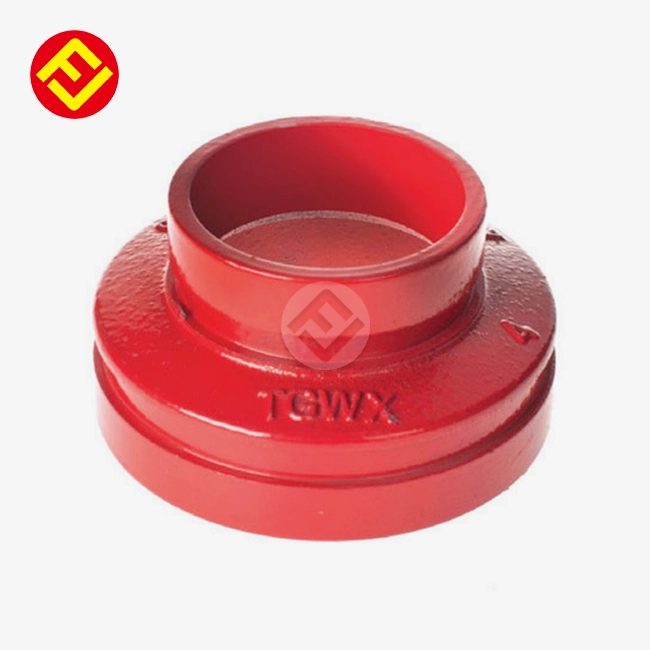
Specialized mechanical pipe fittings called grooved reducer are made to connect pipes with different sizes while keeping the center line perfectly straight. These fittings are made from high-quality ductile iron that meets ASTM A536 Grade 65-45-12 standards. The ends can be roll-grooved or cut-grooved so that they can connect to mechanical joints. Grooved systems are safer for repair jobs than standard welded transitions, which need hot work permits, edge preparation, and X-ray inspection.
Because of how they are made, there is very little noise and maximum hydraulic efficiency. This makes them necessary for fire safety systems, HVAC pump rooms, and city water distribution networks. They meet strict standards, such as ANSI/AWWA C606 specifications, and can handle working pressures between 300 psi and 1000 psi, based on the coupling setup. Surface treatments like hot-dip galvanizing or epoxy resin coating protect against rust in harsh settings, and with proper care, they can last longer than 20 years.
Defining Reducing Couplings
Reducing couplings are a larger group of parts made for making quick changes in width without having to prepare the ends with grooves. These parts come in threaded, bonded, or compression styles and can be used with carbon steel, stainless steel, brass, and PVC, among other materials. Because they are structurally simple, they can be used in light-duty situations where pressure needs to be mild and they don't need to be taken apart often.
For NPT connections, installation usually needs threading compound, and for socket-weld types, it needs fusion welding. When it comes to simple home plumbing, reducing connections are cheaper, but they don't have the seismic freedom and vibration attenuation that grooved systems do. Different materials and connection types have very different pressure ratings. For example, PVC has a rating of 150 psi, while forged steel threaded joints in high-pressure oil and gas uses have a rating of 3000 psi.
Operational Principles in Piping Systems
The main job of both fits is to change the width of a pipe, but they work in very different ways. External mechanical links with EPDM or nitrile covers make leak-proof seals for grooved concentric reducers. Radial compression is used by the housing to spread the load evenly around the gasket seat. It also allows controlled angular movement to account for heat expansion.
For joint stability, reducing couplings depend on the amount of thread engagement or the quality of the weld penetration. For threaded versions, you need to use the right amount of power to avoid galling or cross-threading. For welded versions, you need skilled labor and, for some alloys, a heat treatment after the welding process. Accessibility for maintenance is a key difference. With grooved systems, field teams can take apart parts using only wrenches, instead of using torches, which is safer in places like mines and chemical plants where explosive dust is common.
Key Differences Between Grooved Concentric Reducers and Reducing Couplings
Structural and Dimensional Characteristics
The most obvious difference for grooved concentric reducer is the way the end connections are made. As required by ANSI/AWWA C606, grooved reducer have carefully machined groove shapes with certain 'C' dimension (average groove diameter) and 'A' dimension (gasket seat width) limits. This level of accuracy in measurements means that Products" target="_blank" style="color:blue" >products from different brands will work together. However, it is still best to stick to the same brand for high-pressure systems that go over 500 psi to keep the guarantee valid.
Design uncertainty is higher for reducing connections. Threaded types meet the requirements of ANSI/ASME B1.20.1 for NPT threads, and socket-weld types meet the requirements of ASME B16.11. DN65 to DN300 is the size range for most grooved reducers, which is enough for commercial and light industry uses. Customized designs that are made just for one purpose go beyond these limits. Reducing couplings come in a wider range of sizes, from 1/8" to 24" nominal diameter, so they can fit both small-bore measurement lines and big transmission mains.
Installation Complexity and Labor Requirements
Timelines and wage budgets for projects are greatly affected by how well installations are done. When retrofitting or working in a building that is already occupied and hot work permits are hard to get, grooved circular reducers are a big help. A two-person crew can usually finish a grooved transition with a 6-inch width in less than 15 minutes using standard socket wrenches. This is in contrast to flanged connections that take more than 90 minutes to complete because the bolts need to be lined up and the gasket needs to be centered.
To stop leaks from happening again, threaded reducing joints need to be properly sealed with thread sealer and checked with a torque wrench. If you tighten too much, the threads could strip, and if you tighten too little, the joints could weep when the temperature changes. For welded versions, you need qualified welders, a check after the weld, and time to cool down before you can test the pressure. The grooved method gets rid of these skill dependencies, so assembly teams with fewer specialized skills can keep quality standards high all the time.
Pressure Ratings and Performance Under Stress
The pressure limit for these fitting types changes a lot depending on the material used and the way it is connected. Ductile iron grooved concentric reducers can normally handle up to 750 psi of working pressure with hard couplings and 300 psi with flexible couplings. When used with fire safety systems that need UL/FM approval, they hold up better than threaded options during hydraulic shock events (water hammer), which put most of the stress on the thread roots.
Forged steel threaded reducing couplings can handle more static pressure—Class 3000 versions can handle 3000 psi at room temperature—but they are still not as good at withstanding cycle loading and shaking. Grooved systems have self-compensating movement at the connection joints. This makes them flexible enough to handle changes in temperature and seismic activity without putting too much stress on nearby pipe parts or end equipment.
Cost Considerations and Total Ownership Value
The cost of the materials at the start is only one part of the economic situation. At the component level, threaded reducing couplings may look like they are cheaper, but a lifetime study shows otherwise. When you use grooved systems, you don't have to pay for welding electrodes, shielding gas, grinding discs, or drilling dies over and over again. When workers are more productive, contractors charge less, which is especially helpful when time is of the essence for building projects.
Total ownership costs for grooved reducer are also affected by how easy it is to do maintenance. When grooved piping needs to be changed or parts need to be replaced, teams take apart certain pieces so that whole systems don't have to be drained or long shutdowns are planned. This feature is very useful in production settings that are open 24 hours a day, seven days a week, where downtime costs add up quickly. Cutting couplings often requires cut-and-cap processes, which wastes materials and causes service delays that last longer.
How to Choose Between a Grooved Concentric Reducer and a Reducing Coupling?
Evaluating System Pressure and Fluid Characteristics
The working factors of the system should determine which fitting to use. In normal situations, fire protection networks work with pressures between 100 and 175 psi. But when the pumps start up, they can experience surge pressures of more than 300 psi. grooved reducer work best in this situation because they have approved pressure values and can adapt to changes in pressure. Special coats on grooved fittings help chemical processing systems that deal with harmful fluids. Epoxy phenolic linings can handle alkaline solutions, and fusion-bonded epoxy can handle acidic environments.
Changes in temperature are also important. Grooved gaskets keep closing well over a wider temperature range (-40°F to +230°F for EPDM compounds) than thread seals, which harden or soften outside of their ideal ranges. This temperature stability is especially helpful for HVAC systems that switch between heating and cooling modes, as it lowers the number of calls for leak fixes.
Matching Fittings to Industry Applications
In different fields, different success characteristics are more important than others. Grooved reducers with UL and FM approvals meet Authority Having Jurisdiction requirements right away. Fire sprinkler workers place a premium on installation speed and code compliance. HVAC and mechanical workers like that their insurance rates have gone down and they no longer have to pay for hot work permits when remodeling business buildings that are already occupied.
Municipal water companies that are taking care of old structures like grooved systems because they can be used in a variety of situations. When replacing mains and finding pipes that aren't lined up right, crews change the direction of the couplings to allow up to 4 degrees of angular deflection per joint. This makes up for settled pipe runs without having to spend a lot of money on excavation growth. When working on home jobs, plumbers may choose threaded reducing couplings because they require less pressure and are meant to be installed permanently.
Supplier Certification and Product Availability
Procurement teams should check that the certificates of manufacturers are in line with the needs of the project. UL/FM approvals show that the product is safe for fire safety, and ISO9001 quality management certification shows that the production process is consistent. CE branding is now required for sites in the European Union. Reliable makers keep a lot of stock on hand. For example, FLA Industrial & Trading Co., Ltd. keeps over 2,000 tons of grooved fittings in stock, in both standard and special designs, so they can ship within days instead of weeks.
Ask for material test results that say the ductile iron composition meets the standards of ASTM A536. In particular, ask for nodularity rates that are higher than 90%. Castings that don't have enough nodularity are flimsy and easily break when they are put together. Dimensional inspection papers should show that the grooves 'C' and 'A' are within the allowed ranges of sizes. This will keep the project from being held up by compatibility problems in the field.
Installation and Maintenance Best Practices
Step-by-Step Grooved Reducer Installation
Making sure the pipe ends are prepared is the first step in a proper fitting for grooved concentric reducer. Roll grooving tools make the best shapes for grooved reducer because they keep the thickness of the pipe wall better than cut grooving, which takes away material. Use wire brushes to clean the groove surfaces and get rid of any scale, dirt, or grease that might make it harder for the gasket to close. Before putting the seals together, check them for cuts, distortions, or contamination.
Place the seal around the end of the pipe and make sure it fits completely in the groove without moving. Line up the reducer with the pipe that fits it, and then put the two halves of the coupler case over the joint. To make sure the seal is compressed evenly, put bolts through the housing lugs and hand-tighten the nuts in a star design. To get the torque numbers that the maker specifies, which are usually 75 ft-lbs for 6-inch couplings, use torque wrenches that have been measured. Gaskets get damaged when they are over-torqued, and they leak when they are under-torqued.
Routine Maintenance and Inspection Protocols
Regular checks keep fittings in good shape and stop them from breaking down without warning. Visual checks should be done every three months to see if the coating is wearing off. This is especially important at weld seams and sharp edges, where protection finishes wear off first. Surface rust spots need to be fixed right away. Wire brush the damaged areas and paint over them to stop the rusting from spreading. Check the coupler bolts for rust or loosening, and retorque them if necessary to keep the gasket compressed.
Every year, full checks include checking the state of the gaskets. Take off the coupling housings from the sample joints to check the soundness of the gaskets. Look for compression set (permanent deformation), stiffening, or surface cracking that could mean the gaskets are nearing the end of their useful life. Instead of watching for signs of a leak, replace the seals before they fail. ANSI rules say that test pressures should be 1.5 times the working pressure to make sure that joints are still solid after repair.
Troubleshooting Common Installation Errors
Most leak problems are caused by mistakes that can be avoided. Misaligned lines cause uneven stress of the gasket, which leads to leaks in certain areas. While installing, use alignment bars or laser lines to make sure that the ends of the pipes fit together perfectly. Groove measurement problems, like grooves that are too short or too out of round, make it impossible for the gasket to sit properly. Check the gap depth with calibrated tools before putting the parts together so that problems aren't found during pressure testing.
Another common cause is foreign matter getting stuck under the seals. Pipe dope or pieces of debris get in the way of constant gasket contact, making leak routes. Before installing a seal, you should always check the groove areas and clean them up. Damaged gaskets from bad storing or rough handling fail early. Keep gaskets in climate-controlled areas away from equipment that makes ozone and ultraviolet light.
Conclusion
To choose between grooved reducer and reducing couplings, you need to know how the project's goals match up with the structure design, installation, and working needs. When it comes to installation speed, safety, ease of upkeep, and earthquake resistance, grooved systems are clearly better. This is why they are better for fire protection, HVAC, and city infrastructure. Reducing couplings are still useful in fixed setups that don't need a lot of pressure and have easy access to trained welders. When purchasing professionals look at the total ownership costs instead of just the original material costs, the projects always turn out better. Specification choices can be turned into competitive benefits by working with experienced manufacturers who offer full technical support, certified quality systems, and quick delivery options.
FAQ
Can I Replace a Threaded Reducing Coupling with a Grooved Concentric Reducer?
If a replacement is possible, it depends on how the current pipe ends are maintained and how much room is available. Roll grooving can be done on pipes with plain ends or threads that have been removed using portable tools. This makes installing a grooved reducer possible. Cut grooving can be used on pipes that don't have thick enough walls for roll grooving, but it lowers the pressure values a little. Before moving forward, make sure that the leftover wall thickness is greater than the minimum standards set by AWWA C606. The change gets rid of future servicing problems caused by rusted threads and makes the system more flexible. Talk to the tech teams to make sure that the pressure ratings are compatible and to get the code approval changes that are needed.
What Pressure Limits Apply to Grooved Reducers in HVAC Systems?
Standard flexible grooved connections with ductile iron reducers can safely handle working pressures of up to 300 psi, which is much higher than what most HVAC systems need. Systems that heat and chill water rarely work above 150 psi, which gives them a lot of safety margin. For certain uses, rigid coupling setups raise the values to 750 psi. Always make sure that the specs for the coupler, reducer, and gasket match. Putting together parts from different pressure classes can damage the system. Temperature is also important. Standard EPDM seals work consistently between 40°F and 230°F, which is the normal temperature range for HVAC systems, without worrying about material degradation.
How Do I Ensure Compatibility When Ordering Custom Sizes?
Give accurate pipe outer diameters, wall schedules, and needed transition ratios as part of your precise specs. Demand detailed models that show groove shapes with 'C' and 'A' sizes that meet ANSI/AWWA C606 standards. Tell them what kind of surface finish they need—painted, epoxy-coated, or galvanized—based on how they will be exposed to the outdoors. Reliable makers, such as FLA Industrial & Trading Co., Ltd., offer technical help to improve custom designs and find any interference problems before they are made. Ask for sample approvals for big orders so that you can test-fit them physically before committing to full production runs. Keep detailed records of custom specs to make it easier to reorder in the future and make sure that everything stays the same from one project step to the next.
Partner with FLA Industrial & Trading Co., Ltd. for Reliable Grooved Piping Solutions
FLA Industrial & Trading Co., Ltd. has everything that purchasing managers need in a grooved reducer provider they can trust. We have been making ductile iron fittings for almost 40 years and have over 2,000 tons of stock. We can make standard and special fittings that meet UL, FM, CE, and ISO9001 certification requirements. Within 48 hours, our engineering team can give you a quick price that includes weight estimates and 3D design help that is made just for you. We can handle orders of any size, from five pieces to five thousand pieces. There are no minimum buy requirements. Working with a trusted partner that works with Fortune Global 500 companies in the US, Germany, and Australia can be helpful. Get in touch with our expert sales team at sales@flaindustrial.com to talk about your pipe system needs and find out how our proven quality and low prices can help your project succeed faster.
References
American Water Works Association (2020). ANSI/AWWA C606 Standard for Grooved and Shouldered Joints. Denver: AWWA Publications.
Chauhan, R. K., & Singh, T. (2019). Comparative Analysis of Mechanical Pipe Joining Systems in Fire Protection Applications. Journal of Fire Protection Engineering, 29(3), 245-267.
National Fire Protection Association (2021). NFPA 13: Standard for the Installation of Sprinkler Systems. Quincy: NFPA Press.
Smith, J. L., & Anderson, M. P. (2018). Ductile Iron Pipe: Design and Installation for Water Distribution Systems. American Society of Civil Engineers.
Thompson, W. G. (2022). HVAC Piping Systems: Installation and Maintenance Best Practices. McGraw-Hill Professional.
United States Department of Labor (2020). OSHA Technical Manual: Hot Work Permit Programs for Construction and Maintenance. Washington: Occupational Safety and Health Administration.