Coupling Clamp Grooved Designs for Fast Pipeline Installation
2026-08-05 10:58:14


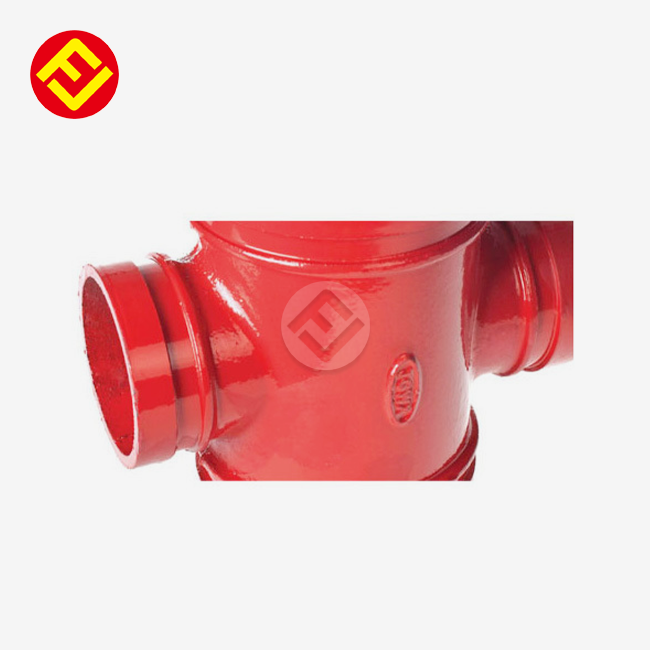
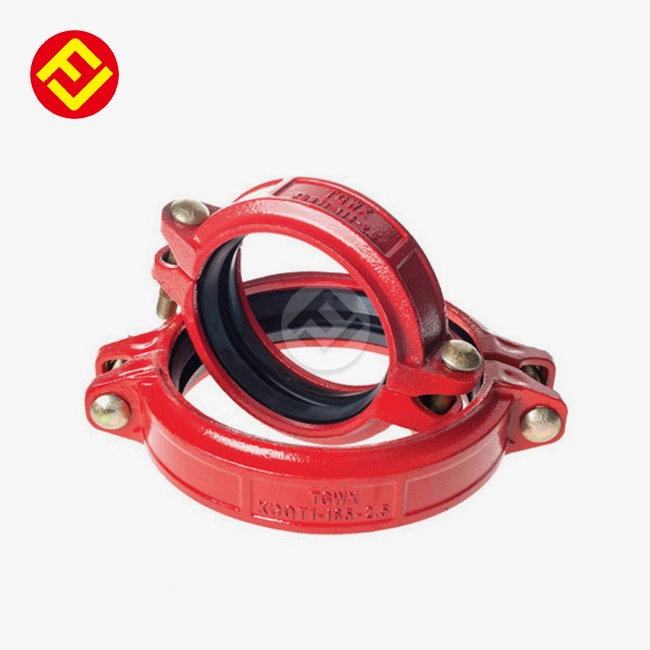
When you need secure, efficient pipe connections for demanding industrial applications, coupling clamp grooved systems deliver unmatched speed and reliability. These mechanical connectors utilize precision-engineered grooves on pipe ends and two-piece housings secured with bolts to create leak-proof joints without welding. Manufactured from ductile iron or carbon steel and available in painted, epoxy coated, or hot-dip galvanized finishes, grooved coupling designs reduce installation time by up to 50% compared to traditional joining methods while accommodating thermal expansion and system vibration. This technology has revolutionized pipeline assembly across fire protection, HVAC, water supply, and industrial processing sectors.


Specification |
||||
| Specification | Size (inch) | L(mm) | H(mm) | Diameter (mm) |
| 1 | 33 | 98 | 42 | 54 |
| 1% | 48 | 114 | 43 | 69 |
| 2 | 60 | 127 | 43 | 32 |
| 2/2 | 76 | 145 | 44 | 99 |
| 3 | 89 | 159 | 44 | 112 |
| 4 | 108 | 186 | 47 | 133 |
| 4 | 114 | 192 | 47 | 140 |
| 5 | 133 | 214 | 48 | 161 |
| 5 | 140 | 221 | 167 | |
| 6 | 159 | 245 | 49.5 | 189 |
| 165 | 251 | 49.5 | 195 | |
| 168 | 254 | 49.5 | 198 | |
| 8 | 219 | 324 | 59 | 254 |
| 10 | 273-1.6 | 416 | 61 | 316 |
| 10 | 273-2.5 | 416 | 62 | 317 |
| 12 | 325-1.6 | 467 | 61 | 370 |
| 12 | 325-2.5 | 469 | 62 | 372 |
Understanding Coupling Clamp Grooved Technology
Coupling Clamp Grooved technology represents a fundamental shift from welding-dependent methods to mechanical assembly systems that prioritize speed, safety, and adaptability. At its core, this technology employs a circumferential groove—either roll-formed or cut into the pipe's outer surface—which engages with corresponding keys inside the coupling housing segments.
Core Components and Design Principles
The system consists of four essential elements working in harmony. The pipe groove itself, machined or rolled according to ANSI/AWWA C606 dimensional standards, provides the mechanical anchor point. The coupling housing, typically cast from ductile iron conforming to ASTM A536 Grade 65-45-12, features inward-facing keys that lock into the pipe groove. A pressure-responsive EPDM or nitrile rubber gasket creates the hydraulic seal, while track-head bolts with carbon steel construction secure the assembly. This design eliminates hot work hazards associated with welding, a significant safety consideration for contractors working in occupied buildings or hazardous environments.
Material Selection Impact on Performance
Material choice directly influences system longevity and application suitability. Ductile iron Coupling Clamp Grooveds offer tensile strength of 65,000 psi with 12% elongation, providing excellent impact resistance for demanding installations. Carbon steel variants deliver superior resistance to mechanical stress while maintaining lighter weight profiles. Surface treatments extend service life dramatically—epoxy coatings withstand corrosive environments in chemical processing plants, while hot-dip galvanized finishes excel in outdoor water supply networks exposed to weather fluctuations. We manufacture our Coupling Clamp Grooveds with precision casting processes followed by CNC machining to ensure dimensional accuracy within 0.5mm tolerances, critical for proper gasket compression and leak prevention.
Rigid Versus Flexible Coupling Variants
Within the Coupling Clamp Grooved family, there are two main design groups that meet different practical needs. When two housing pieces meet at a rigid coupling, the tongue-and-groove surfaces stop any angular or linear movement. They work like bonded joints but with the speed benefits of mechanical assembly. Flexible joints let you bend pipes up to 4 degrees and move them linearly up to 0.5 inches. This means that they can adapt to thermal expansion in HVAC cold water loops and seismic drift in high-rise sprinkler shafts. This adaptability keeps damaging forces away from equipment further down the line while keeping the integrity of the seal in changing circumstances.
Advantages of Using Grooved Coupling Clamps for Pipeline Installation
Procurement managers and project engineers consistently cite installation speed as the primary advantage driving adoption of Coupling Clamp Grooved technology. Where traditional welding requires certified welders, fire watch personnel, and ventilation equipment, Coupling Clamp Grooved assembly needs only basic hand tools and semi-skilled labor.
Quantifiable Time and Cost Savings
Field studies conducted across commercial construction projects demonstrate that Coupling Clamp Grooved systems reduce joint assembly time from 15 minutes per connection (welding) to under 3 minutes (Coupling Clamp Grooved). This 80% reduction translates directly to labor cost savings, particularly valuable for contractors managing tight project schedules. The elimination of hot work permits accelerates installation in operational facilities where welding restrictions cause costly delays. Our ISO9001-certified manufacturing processes ensure dimensional consistency across production runs, meaning installers achieve first-time-right assembly without field modifications that plague welded systems.
Vibration Dampening and System Protection
The rubber seal inherent to Coupling Clamp Grooved designs provides mechanical isolation between pipe sections, dampening vibration transmission from pumps and mechanical equipment. This characteristic proves essential in HVAC installations where noise control affects building occupant comfort. The gasket's C-shaped cross-section creates a dynamic seal that actually improves under internal pressure—as line pressure increases, the gasket compresses more firmly against sealing surfaces. This pressure-responsive behavior maintains leak-free performance across wide pressure ranges, from vacuum conditions in condensate return lines to 300 PSI in fire protection systems.
Compliance with International Standards
Our Coupling Clamp Grooved fittings carry UL, FM, and CE certifications, demonstrating compliance with rigorous safety and performance standards required for fire protection applications. These certifications matter significantly to procurement teams managing liability exposure and insurance requirements. Products" target="_blank" style="color:blue" >products meeting ASTM F1476 and AWWA C606 standards undergo hydrostatic burst testing at 3:1 safety factors, meaning a Coupling Clamp Grooved rated at 300 PSI withstands over 900 PSI before failure. This engineering margin provides confidence for engineers specifying systems with future expansion possibilities or occasional pressure spikes during operation.

Comparative Analysis: Grooved Coupling Clamps vs. Alternative Connection Methods
When procurement workers know how Coupling Clamp Grooved technology compares to traditional joining methods, they can make better sourcing decisions aligned with project requirements and budget constraints.
Grooved Versus Welded Connections
Welded joints create permanent, rigid connections requiring specialized labor and creating fire hazards during installation. Coupling Clamp Grooved assemblies eliminate these concerns while maintaining comparable pressure ratings and mechanical strength. The modular nature of Coupling Clamp Grooved systems simplifies future modifications—maintenance teams can disassemble joints for equipment access without cutting pipes, then reassemble using existing components. This advantage proves particularly valuable in industrial facilities where process modifications occur regularly. Welding also introduces metallurgical changes at heat-affected zones that can compromise corrosion resistance, while Coupling Clamp Grooved connections preserve base pipe properties throughout the system.
Grooved Versus Flanged Systems
Flange connections offer disassembly advantages similar to Coupling Clamp Grooveds but impose significant weight and space penalties. A 6-inch flanged joint weighs approximately 45 pounds compared to 8 pounds for an equivalent Coupling Clamp Grooved, affecting structural loading calculations and installation ergonomics. Flange bolt patterns require precise alignment and multiple fasteners, complicating installation in confined spaces common to mechanical rooms. Coupling Clamp Grooved connections accommodate minor misalignment during assembly, reducing installation frustration and speeding completion. The compact profile of Coupling Clamp Grooved housings also provides clearance advantages in crowded pipe racks where every inch matters.
Material Trade-offs: Ductile Iron Versus Carbon Steel
Because they have been used for a long time and have been approved by FM, ductile iron Coupling Clamp Grooved joints are the most common type used in fire protection. Carbon steel variants offer weight savings beneficial for large-diameter installations where material handling becomes physically challenging. Our engineering team assists procurement professionals in material selection based on environmental factors—carbon steel with appropriate coatings suits most industrial applications, while ductile iron provides superior impact resistance for installations vulnerable to mechanical damage. Both materials undergo identical quality control protocols including spectrographic analysis and dimensional verification before shipment.
Procurement Guide for Coupling Clamp Grooved
Successful sourcing of Coupling Clamp Grooved components requires attention to technical specifications, supplier capabilities, and total cost of ownership considerations extending beyond initial purchase amounts.
Specification Development and Sizing
Proper sizing begins with accurate pipe outer diameter measurement rather than nominal size designation, as manufacturing tolerances affect Coupling Clamp Grooved dimensions. Our technical support team provides sizing assistance within 24 hours of inquiry, recommending appropriate Coupling Clamp Grooved series based on working pressure, temperature range, and pipe schedule. Size availability spans 1 inch to 48 inches, covering applications from residential fire sprinkler branches to municipal water transmission mains. Working pressure ratings reach 300 PSI for standard configurations, with special designs available for higher pressure requirements in industrial processing environments.
Evaluating Supplier Capabilities
Hardware distributors and tool wholesalers prioritize suppliers offering diverse SKU options with consistent availability supporting just-in-time inventory strategies. We maintain stock depth across our complete size range, enabling rapid fulfillment of both small quantity orders and bulk container shipments. Packaging quality matters significantly for distributors—our export-grade wooden cases prevent damage during international transit while facilitating efficient warehouse handling. Custom labeling and documentation services support distributors serving multiple customer segments with varying technical requirements.
After-Sales Support and Technical Assistance
Construction contractors and project engineers value suppliers providing installation guidance and troubleshooting support throughout project lifecycles. Our technical team offers on-site installation training ensuring crews understand proper gasket seating, Coupling Clamp Grooved torque specifications, and alignment procedures that prevent field failures. Warranty policies backed by comprehensive documentation create confidence in product reliability while protecting against manufacturing defects. Spare parts availability ensures maintenance teams can service systems years after initial installation, a consideration often overlooked during procurement but critical for lifecycle cost analysis.
Installation and Maintenance Best Practices for Grooved Coupling Clamps
Even the highest-quality Coupling Clamp Grooveds fail without proper installation procedures and routine maintenance protocols. Understanding common pitfalls and best practices maximizes system reliability and service life.
Preparation and Assembly Procedures
Surface preparation determines seal effectiveness—pipe ends must be clean and free from mill scale, dirt, or corrosion that prevents proper gasket contact. The gasket seats into the Coupling Clamp Grooved housing groove before positioning on the pipe, with the gasket's center rib aligned with the pipe groove. Housing segments then position around the pipe with keys engaged in the groove before finger-tightening bolts. Torque application follows a cross-pattern sequence, tightening bolts incrementally rather than fully tightening one bolt before moving to the next. This approach ensures even gasket compression and prevents gasket pinching that causes leaks.
Common Installation Errors and Prevention
Misalignment represents the most frequent installation error, occurring when pipe ends meet at angles rather than concentrically. This condition stresses the gasket asymmetrically, creating leak paths under pressure. Using alignment tools or temporary supports maintains concentricity during assembly. Insufficient groove depth—particularly common with worn roll grooving tools—prevents proper key engagement, allowing the pipe to pull out under pressure surges. Verifying groove dimensions with depth gauges before assembly catches this issue before it becomes a system failure. Our products ship with detailed installation instructions including torque specifications and troubleshooting guides supporting field personnel.
Maintenance Protocols and Inspection Schedules
Regular visual inspections identify early warning signs of component degradation before leaks develop. Inspectors check for rust staining around housing edges indicating gasket compression loss, bolt corrosion requiring replacement, and coating damage exposing base metal to atmospheric attack. Mechanical rooms with HVAC equipment benefit from quarterly inspections due to vibration exposure, while fire protection systems in controlled environments may extend inspection intervals to annual frequency. Documentation of inspection findings creates maintenance history supporting predictive replacement strategies. Gasket replacement during system modifications uses only manufacturer-specified materials—substituting incompatible gasket compounds leads to rapid seal degradation and system contamination.

Conclusion
In conclusion, when installing pipelines in a variety of industrial settings, Coupling Clamp Grooved technology offers clear benefits. It speeds up the installation process and makes it easier to do repairs. You can choose from ductile iron and carbon steel as materials, as well as different surface finishes and rigid or flexible designs. This lets you get the best performance and working conditions. For procurement to go well, the initial costs of the parts must be weighed against their lifetime costs, which include things like labour for installation, ease of maintenance, and durability over time. Coupling Clamp Grooved systems are great for contractors who have to keep track of complicated project schedules and safety rules because they get rid of the dangers of hot work and the need for skilled labour. As factories try to be more flexible with their operations and reduce the amount of work that needs to be done, Coupling Clamp Grooved technology is being used more and more in fire protection, HVAC, water supply, and process pipes around the world.
FAQ
What distinguishes rigid from flexible grooved couplings in practical applications?
Rigid Coupling Clamp Grooveds create fixed joints similar to welded connections, preventing angular or linear pipe movement while maintaining mechanical assembly advantages. These suit applications requiring precise alignment such as vertical risers in fire protection systems. Flexible Coupling Clamp Grooveds accommodate controlled deflection and thermal expansion, making them ideal for HVAC chilled water loops experiencing temperature cycling and equipment vibration isolation. Selection depends on whether your system requires movement accommodation or rigid alignment.
How do I select appropriate gasket materials for different fluids?
EPDM gaskets perform well with water, sewage, and steam up to 230°F but degrade rapidly when exposed to petroleum products or hydrocarbon-based fluids. Nitrile (NBR) gaskets resist oil-based fluids, hydraulic fluids, and petroleum products but show reduced performance with certain chemical exposures. Our technical team reviews your application fluid chemistry and operating temperature range to recommend compatible gasket compounds meeting your specific requirements.
What quality control measures ensure coupling reliability?
Every production batch undergoes hydrostatic burst testing at pressures exceeding rated working pressure by safety factors of 3:1 or greater. Dimensional verification using coordinate measuring machines confirms housing key dimensions and Coupling Clamp Grooved tolerances meet ANSI/AWWA C606 specifications. Spectrographic analysis validates material composition, ensuring ductile iron meets ASTM A536 Grade 65-45-12 requirements for tensile strength and elongation properties. Salt spray testing per ASTM B117 confirms coating durability for corrosive environment applications.
Partner with FLA Industrial & Trading Co., Ltd. for Premium Grooved Coupling Solutions
Picking the correct Coupling Clamp Grooved provider can affect the success of your project, the time it takes to deliver, and the long-term dependability of your system. FLA Industrial & Trading Co., Ltd. has been making things for almost 40 years and works with hardware stores, building companies, and corporate procurement teams all over North America. Our wide range of products, from 1 inch to 48 inches, is made with ductile iron and carbon steel. They are all made according to ISO9001 quality standards and have CE and UL/FM certifications. Within 24 to 48 hours of receiving your request, we will provide technical support, which includes help with unique sizing, 3D design files, and installation instructions. Partners in the Fortune Global 500 trust us to offer competitive bulk pricing without compromising quality standards, supported by flexible payment terms and reliable container shipment schedules. Contact our sales team at sales@flaindustrial.com to discuss your Coupling Clamp Grooved requirements, request quotations, or explore custom solutions tailored to your specific application demands.
References
1. American Water Works Association. (2020). AWWA C606: Grooved and Shouldered Joints. Denver: AWWA Standards.
2. ASTM International. (2019). ASTM A536: Standard Specification for Ductile Iron Castings. West Conshohocken: ASTM Technical Publications.
3. National Fire Protection Association. (2021). NFPA 13: Standard for the Installation of Sprinkler Systems. Quincy: NFPA Press.
4. Underwriters Laboratories. (2018). UL 213: Standard for Rubber Gasketed Fittings for Fire Protection Service. Northbrook: UL Standards Department.
5. Factory Mutual Research Corporation. (2022). FM Class 1920: Approval Standard for Grooved Pipe Couplings and Fittings. Johnston: FM Approvals.
6. Mechanical Contractors Association of America. (2021). Grooved Mechanical Piping Systems: Installation and Best Practices. Rockville: MCAA Technical Publications.