Grooved Elbow Fittings with High Strength and Corrosion Resistance
2026-07-17 11:36:41


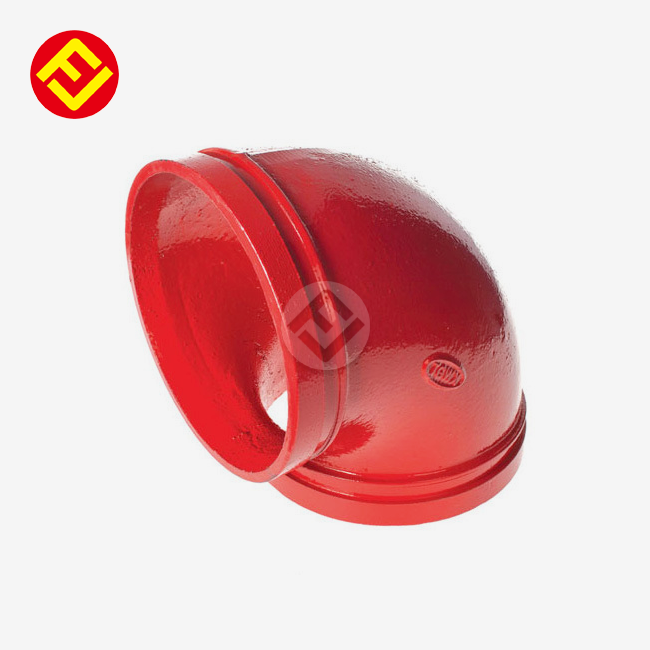
When industrial pipe systems need to change directions reliably without affecting the structure, Grooved Elbow fittings are the best choice. These unique parts are both mechanically efficient and long-lasting. They can be installed using a cold-formed method that avoids the fire risks of welding while still providing excellent pressure resistance. Grooved Elbows are made mostly of ductile iron and carbon steel, and they have advanced surface treatments that protect them from corrosion and give them high tensile strength. These are important qualities for fire protection networks, HVAC installations, and water distribution systems, where downtime directly leads to lost productivity and safety risks.

Specification |
|||
| Nominal Diameter(mm) | Steel Pipe Outer Diameter(mm) | Nominal Pressure(MPa) | Unit |
| 50 | 60 | 2.5 | Piece |
| 65 | 76 | 2.5 | Piece |
| 80 | 89 | 2.5 | Piece |
| 100 | 114 | 2.5 | Piece |
| 125 | 140 | 2.5 | Piece |
| 150 | 165 | 2.5 | Piece |
| 200 | 219 | 2.5 | Piece |
Understanding Grooved Elbow Fittings: High Strength & Corrosion Resistance Explained
What Makes Grooved Elbows Structurally Superior
Grooved mechanical pipe systems are a step forward in how we handle changes in the direction of fluid flow. Instead of the usual bonded connections, these fittings have precisely machined holes on both ends that fit together with mechanical joints and elastomeric seals. The design takes into account things like thermal expansion, seismic movement, and vibration dampening, which are things that make rigid welded systems fail early. The groove sizes are in line with ANSI/AWWA C606 standards, which means that they will work with all pipe schedules and coupling manufacturers.
The engineers who made these fittings solved one of the biggest problems in industrial piping: how to balance flexibility with load-bearing capacity. A 90-degree Grooved Elbow made of ductile iron that meets ASTM A536 Grade 65-45-12 has a minimum tensile strength of 65,000 psi and a maximum extension of 12%. This combo makes it possible for the fitting to handle shock loads and sudden changes in pressure without breaking, which is a common way for brittle cast iron alternatives to break.
Material Selection and Corrosion Protection Technologies
The choice of material has a direct effect on how long something will last in harsh environments. Ductile iron is great for fire sprinkler systems because it can withstand impacts better and be easily machined. This makes it perfect for situations where parts may be hit by accident during building or maintenance. Different types of carbon steel are stronger for high-pressure uses, like in industrial cooling loops where the working pressure is over 500 psi.
Surface treatment technology has come a long way since the days of simple painting. Hot-dip galvanization according to ASTM A153 forms a mechanical bond between the zinc and the base metal. This bond protects the metal even if the coating gets slightly damaged. Epoxy powder coats in bright red or orange colors do two things: they protect against rust and make it easier to find things in complicated networks of pipes. During quality control, dry film thickness scales are used to make sure that the coating is thicker than 80 microns. This provides long-lasting protection against chemical and wetness exposure.
Pressure Ratings and Size Compatibility Across Applications
The working pressure of a Grooved Elbow depends on the type of coupling, the pipe schedule, and the system design pressure. Standard designs can handle working pressures between 300 psi and 690 psi. Specialized high-pressure designs can handle 1,000 psi when paired with the appropriate couplings and gaskets. The pressure rating needs to consider both static head and water hammer effects in systems with quick-closing valves. This is especially important for fire suppression networks where sprinklers activate rapidly and cause sudden flow changes.
Nominal pipe sizes range from 1 inch to 48 inches, but the most usual range for industrial use is between 2 inches and 12 inches in diameter. The standard and short versions of the elbow have different internal radii that change how the pressure drop is calculated. When compared to mitered options, a standard radius elbow makes the flow transfer smoother and loses about 30% less friction. This means that pumped systems use less energy and hydraulic formulas are more accurate.
Comparing Grooved Elbows with Traditional Fittings for Optimal Procurement
Installation Speed and Labor Cost Analysis
In building jobs, time is money, especially when there aren't enough workers to keep hourly rates low. Installing a welded elbow takes 45 to 90 minutes per joint and needs qualified welders, hot work permits, fire watch staff, and post-weld checks. This takes only 5 to 10 minutes per link with grooved systems, which only need basic hand tools and semi-skilled labor. When working on big projects, the productivity boost is exponential. For example, a mechanical contractor installing 200 joints in a high-rise sprinkler system saves 120 to 160 hours of work compared to welding.
There are some problems with threaded connections. Cutting threads weakens the walls of pipes, making stress points that are more likely to crack when the pipes are shaken. During the threading process, metal shavings get into the system fluids and damage valve seats and pump seals. These problems don't happen at all with grooved systems, which keep the full thickness of the pipe wall throughout the connection zone.
Maintenance Accessibility and System Modifications
Facility management teams like being able to change the layout of pipes without having to take equipment offline for long periods of time. Grooved valves can be taken apart and put back together without hurting the pipe. This makes it easy to get to the equipment or change the way the system is set up. A hospital's HVAC system that needs a new chiller can disconnect grooved piping in hours instead of days. This means that areas like operating rooms and intensive care units (ICUs) will be less affected by the change in temperature.
The elastomeric gasket in grooved couplings adds to the acoustic isolation, lowering noise transmission in occupied areas. This is becoming a requirement that is written into more and more HVAC contracts for hotels, hospitals, and residential buildings. Welded systems send noise and vibrations straight through hard metal-to-metal contact, which is why expensive vibration isolators are often needed at pump connections.
Lifecycle Cost Comparison Across System Types
Buying choices involve more than just the original price. They also include the cost of labor for installation, the cost of repairs, and the cost of replacements after 25 to 30 years of use. Grooved fittings cost more in materials than welded ones, but when labor and project timeline are taken into account, the total installed cost usually favors grooved systems by 15 to 25 percent.
Coated grooved fittings protect against rust naturally, which greatly increases the time between upkeep tasks. In an outdoor cooling tower setting, a galvanized Grooved Elbow can last 20 years or more with little to no surface corrosion. On the other hand, uncoated welded steel fittings need to be replaced every 8 to 12 years because oxidation on the outside weakens the wall thickness. Being able to check the state of the gasket during regular maintenance without taking the joint apart gives early warning of seal degradation, which stops sudden failures that cause water damage and business loss.

Procurement Guide: How to Buy Grooved Elbow Fittings for B2B Clients
Certification Requirements and Standards Compliance
Manufacturers with a good reputation maintain third-party certifications that show their Products" target="_blank" style="color:blue" >products meet safety and performance standards. The ISO9001 quality management system certification shows that the manufacturing methods and tracking standards are always the same. Because these certifications are often required by building codes, UL and FM approval is especially important in fire protection applications.
Destructive tests, dimensional proof, and regular workplace checks to make sure compliance are all part of the certification process. When looking at possible suppliers, ask for certification documents and check their validity in the database of the organization that issued them. Products that don't have the right certifications may seem cheap at first, but they come with risks of damage and inspection rejection that are much greater than any savings in price.
Evaluating Supplier Capabilities and Quality Assurance
Controlling the casting process and inspecting it thoroughly are directly linked to the quality of the product being made. To get the right mechanical qualities, the spheroidization rate of ductile iron—that is, the number of graphite nodules that become spherical—must be higher than 90%. Reputable foundries use metallographic microscopy to look at random production samples and record the matrix structure and nodularity. Ask for these material test results when you are evaluating suppliers.
How well a joint works and how reliable a seal is depends on how accurate the groove's measurements are. Go/no-go gauges are used by good makers to make sure that the groove diameter, width, and gasket seat measurements are within the allowed ranges. Deviations can make it hard to install the coupling or create leak paths that go past the gasket. Testing the casting under four times its working pressure for porosity that could lead to failures in the field under normal conditions is done by hydrostatic testing.
Bulk Ordering Strategies and Customization Options
Large contractors and hardware distributors can save money and time by building relationships with preferred suppliers that guarantee stable prices and a steady supply of goods. When you arrange bulk purchasing deals for yearly amounts, you can usually get lower prices and make sure you have enough supplies when the supply chain is interrupted. The supplier's inventory depth is important; keeping more than 2,000 tonnes of stock on hand makes sure that standard sizes can be filled quickly and without any production delays.
In industrial settings, custom needs like non-standard angles, special coatings, or changes to the size to fit existing infrastructure come up all the time. Suppliers that offer OEM services and tech help can make custom-shaped parts that are exactly what you need. Custom production usually has lead times between 7 and 15 working days, which is a lot shorter than the 6 to 8 weeks that are common in this industry, and helps keep project schedules on track.
Installation and Maintenance of Grooved Elbow Fittings to Maximize Performance
Step-by-Step Installation Protocol for Field Technicians
Preparing the pipes is the first step in a proper installation. If you want to cut the ends of pipes perfectly, you should use approved cutting tools like abrasive saws or motorized cutters instead of torch cutting, which can leave heat-affected areas and measurement errors. To keep the seal from getting damaged during connection assembly, deburr both the inside and outside edges. Check that the groove was cut or rolled correctly according to the manufacturer's instructions. Use accurate tools to check the depth and width of the groove.
Set the elbow at the angle you want, and make sure the pipe ends fit snugly against the shoulder inside the fitting. Put the gasket around the joint so that it is in the middle of the groove. When you put the coupling housing pieces in place, make sure that the coupling key fits into the gap on both sides. Tighten the bolts in a star pattern to the torque level recommended by the coupling maker. Depending on the pipe size, this is usually 45 to 75 ft-lbs. When you over-tighten, the gasket gets crushed, but when you under-tighten, the joint can separate under pressure.
Routine Inspection and Preventive Maintenance Practices
Visual inspections should be done every six months during the launch year. Once the system is stable, they should be done once a year. If you see gasket extrusion (rubber sticking out past the coupling housing), that means there is too much pressure, thermal cycling, or bad installation. The condition of the surface coating shows that corrosion is present. Any damage to the coating should be fixed right away with approved touch-up materials that match the original finish.
Check the strength of the coupling bolts once a year in places where they will be moving, like pump discharge lines. Vibration can slowly loosen bolts, which can damage the structure of a joint. Write down the torque numbers and tighten again to the specs if the values have dropped. Systems that are subject to freeze-thaw cycles need extra care because ice building up in drained lines can damage coatings and warp seals.
Real-World Performance in Critical Applications
As part of a project to improve fire safety in 15 commercial buildings in the Midwest, old threaded steel pipes were replaced with grooved ductile iron pipes and Grooved Elbow fittings. The contractor finished the installation 40% faster than the original estimate. This saved time because adverse weather conditions that would have delayed threaded installation in freezing temperatures were avoided. When the system was inspected after five years of use, it showed no joint leaks and only minor surface corrosion, even though it had been exposed to outdoor conditions. This proved that epoxy-coated fittings provide effective protection against corrosion.
As production plans change, so does the temperature in an industrial HVAC system that serves a pharmaceutical manufacturing plant. The grooved pipe system allows for heat expansion without putting stress on the links between pieces of equipment. This gets rid of the problems with cracked welds and failed threaded joints that existed in the old system. Compared to the five years before the grooved system retrofit, maintenance records show that 75% fewer emergency pipe repairs have been made.
Why Choose High-Strength & Corrosion-Resistant Grooved Elbow Fittings?
Operational Benefits That Impact Your Bottom Line
Unplanned downtime costs factories thousands of dollars an hour in lost production, so making sure systems work well is a top priority. High-strength grooved valves can handle pressure spikes and water hammer events that break lower-quality parts, which lowers the number of times that emergency repairs need to be done. The resistance to rust makes service times longer, so maintenance teams can focus on making things work better instead of fixing problems when they happen.
Safety compliance is another important factor. When called upon, fire prevention devices must work reliably, often after years of standby service. Grooved fittings that don't rust keep their full flow capacity throughout their service life. This makes sure that sprinkler systems give the design flow rates during fires. This dependability meets insurance requirements and keeps people and property safe.
Scalability for Complex Multi-Building Projects
Grooved systems are useful for large campus projects like universities, hospitals, and industrial parks because they are adaptable. Using grooved connections in all buildings makes it easier to keep track of inventory, cuts down on the time needed to train maintenance staff, and speeds up the repair process when it's needed. When compared to field-welded options, the ability to prefabricate piping assemblies off-site speeds up construction schedules and improves quality control.
Future Trends in Material Technology and Sustainability
As coating chemistry improves, it makes things more resistant to corrosion and better able to work with different environments. Water-based epoxy formulas keep their protective properties while lowering volatile organic compound pollution during production. More and more suppliers are selling products that are made with recycled materials, which helps LEED certification goals without changing the products' technical qualities.
The move toward smart buildings and predictive repair opens up chances to use sensors. Grooved systems are better than welded systems at fitting non-invasive flow meters, pressure transducers, and vibration sensors. This makes condition tracking possible, which can predict breakdowns before they happen. This method is based on data and helps keep repair costs low while also extending the life of assets.

Conclusion
Grooved Elbow fittings are strong and won't rust. They are a tried-and-true way to solve problems with industrial pipes in plumbing, HVAC, fire protection, and process areas. Hardware dealers, contractors, and building owners can all see a measured value in products that are easy to maintain, can be installed quickly, and last a long time. Improvements in ductile iron casting and surface treatment technologies made possible by advances in material science make sure that these parts meet strict performance standards while keeping costs low over their entire life. When the initial cost of purchase is weighed against the total cost of ownership, grooved systems always show that they are the better choice. Grooved mechanical piping is now the best choice for modern infrastructure projects because standards, materials, and installation methods are always changing.
FAQ
What material offers the best corrosion resistance for grooved elbows?
Ductile iron that has been hot-dip galvanized according to ASTM A153 protects against corrosion very well for use outside and in harsh environments. Although the zinc covering is damaged in some places, it still protects the base metal. When used inside, epoxy powder coats are very good at resisting water and light chemicals. When the right surface treatment is done to carbon steel, it can handle high pressures and maintain its corrosion resistance. The best choice for your purpose will rely on the conditions of exposure, the pressure needs, and the temperature ranges.
Can grooved elbows handle high-pressure industrial systems?
Grooved fittings usually work in systems with working pressures of up to 690 psi, but some special versions can handle 1,000 psi when paired with the right connections and seals. The pressure that can be applied depends on the thickness of the pipe schedule, the design of the coupling, the material of the gasket, and the temperature of the system. Manufacturers give ratings for pressure and temperature that show safe operating ranges. When using high-pressure systems, it's important to pay attention to the coupling bolt torque and the material of the gasket so that the seal stays intact when the system is loaded.
How do I ensure compatibility with existing piping infrastructure?
Grooved fittings manufactured to ANSI/AWWA C606 standards make sure that fittings from different makers are the same size. Make sure that the grooves on your current pipe match the fitting's requirements. Differences in groove depth or width can make it impossible for the coupling to connect properly. Groove sizes are affected by pipe schedule and wall thickness. Make sure that the cutting or grooving equipment you use makes compliant grooves. Transitional fittings let grooved systems connect to threaded or flanged equipment, giving you options for retrofits or system expansions.
Partner with a Trusted Grooved Elbow Supplier for Your Industrial Needs
At FLA Industrial & Trading Co., Ltd., we bring nearly 40 years of manufacturing expertise to every grooved elbow fitting we produce. Our facility maintains a 2,000-ton inventory of standard ductile iron and carbon steel fittings in both 90° and 45° configurations, ensuring rapid fulfillment of your urgent project requirements. We hold ISO9001, UL, FM, and CE certifications, validating our commitment to quality and safety standards recognized across global markets. Custom manufacturing lets you get unique-shaped parts in 7–15 working days, which is faster than the standard in the industry and helps you keep your projects on track. When you Contact Us, our technical team will get back to you within 24 to 48 hours with detailed specifications and application advice that are made to fit your needs. If you're looking for a reliable Grooved Elbow manufacturer for long-term supply agreements or bulk quantities to send out, we are the best choice because our prices are low and our quality has been tested. Contact us at sales@flaindustrial.com to discuss your piping system needs and discover how our products can enhance your project outcomes.
References
1. American Water Works Association. (2020). ANSI/AWWA C606: Grooved and Shouldered Joints Standard. Denver: AWWA Publications.
2. ASTM International. (2019). ASTM A536: Standard Specification for Ductile Iron Castings. West Conshohocken: ASTM Technical Publications.
3. National Fire Protection Association. (2021). NFPA 13: Installation of Sprinkler Systems Handbook. Quincy: NFPA Standards Council.
4. Mechanical Contractors Association of America. (2018). Grooved Mechanical Piping Systems: Installation and Performance Guide. Rockville: MCAA Technical Services.
5. American Society of Mechanical Engineers. (2020). ASME B31.1: Power Piping Code and Commentary. New York: ASME Standards Publication.
6. Ductile Iron Pipe Research Association. (2019). Corrosion Protection Strategies for Ductile Iron Pipe Systems. Birmingham: DIPRA Engineering Department.